return

Return to peasantsplot.com

Friday, November 2, 2012


A SEE-YOU-LATER LETTER....

THE VEGETALBES YOU ATE THIS SEASON were grown with seed from companies that scorn genetically modified seed and care about the state of organic seed.
THE VEGETABLES YOU ATE THIS SEASON were grown on land amended only with composted horse manure from a half mile away and from green manure crops we planted to feed the soil with nitrogen and soil structure. When bugs became a problem on certain crops this year, instead of drowning the crop in pesticides, we lost it and focused on another.  We controlled weeds and bugs by keeping the plants well nourished and using tools like human hands, a cultivating tractor, trap plants, the occasional use of an organic spray called diatamaceous earth, and prayer (crossed fingers).  Because we are a diversified farm with a customer base like you, we can run with the punches when the season throws us a drought or a flood or whatever.  You didn’t get much in the way of leafy greens during July and August and we didn’t get the best yield on butternuts because of the dryness and heat, but we made up for it with other crops like potatoes, carrots, beets and fall greens.  Pretty good season all told.
THE VEGETABLES YOU ATE THIS SEASON were grown by Todd and a sprightly troupe of leprechauns named Meredith, Justin, Laura, Maeve, Dave, Carolyn, and our labor manager Joe Pisciotto.  Thanks to 15 worker shareholders on the farm and 7 worker shareholders off farm. Interns are people curious about this new model of farming, how to get into it, how to change the world, etc. 

WANT TO BE SURE OF ALL THIS?  Next season, come visit.!!  We are a very small farm in our 5th year (3rd at this size). We have lots to learn and lots of infrastructure still to build.  Come visit and see how we make it work.  View our compost pile.  Witness our practices.  Pull a weed.

There’s this myth floating around that “organic can’t feed the world.”  That is a bunch of malarkey.*  Plenty of studies show otherwise, including one that was released last year by the UN Environment Programme.  UNEP reported that organic practices in Africa outperformed industrial, chemical-intensive conventional farming, and also provided environmental benefits such as improved soil fertility, better retention of water and resistance to drought. The Rodale Institute recently completed their report on the longest side-by-side conventional vs. organic farming systems trial ever completed in the U. S.  In this 30-year study, they found organic yields match conventional yields in long-term trials with much less environmental impact.
Most farmland in our country does not “feed the world.” It supplies raw material for cereal, junk food and feed for cows.  By the way.

*read MOSES publication Organic Broadcaster, v. 20, No. 2 or visit www.rodaleinstitute.org/fst30years

Don’t get freaked out.  Feel very very good.  Thanks for making a difference. 
And eat your vitamins.
Your farmers,
Julia and Todd McDonald

Thursday, September 13, 2012

Vodka-Infused Tomatoes

Our favorite beefsteak heirlooms are coming in finally--Moskvitch!
Hot peppers coming in, too.  Jalapenos pictured here while
Black Hungarians getting packed in shares as I type this...

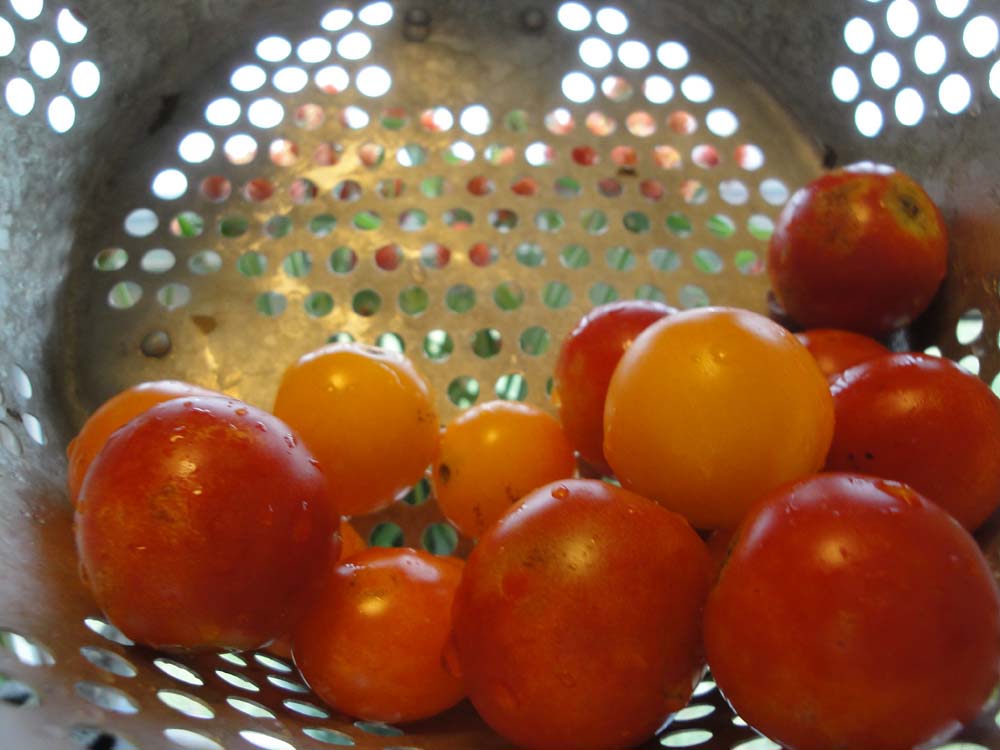
  • Below is an idea for entertaining and good directions for blanching in general.  If you blanch and peel tomatoes, they are ready for freezing or marinating.  I remember a few people did this particular recipe  last year with our cherry tomatoes and loved it.  A virgin variation can be pretty yummy, too.  

  • Adapted from epicurious.com
Vodka-infused Cherry Tomatoes
Ingredients
  • your bag of mixed cherry  tomatoes
  • 1/2 cup vodka
  • 3 tablespoons white-wine vinegar
  • 1 tablespoon superfine granulated sugar
  • 1 teaspoon grated lemon zest
  • 3 tablespoons kosher salt
  • 1 1/2 tablespoons coarsely ground black pepper


Cut a small X in the bottom of each tomato.  
Blanch tomatoes, 5 at a time, in a saucepan of boiling water for 3 seconds. 
 Immediately transfer with a slotted spoon to an ice bath to stop cooking.  
Drain and rub off skins, transferring to a large shallow dish.

Combine vodka, vinegar, sugar and zest until sugar has dissolved.  Pour over tomatoes, gently tossing to coat.  Marinate in the fridge for 30 minutes to an hour.  Stir together salt and pepper and serve with tomatoes for dipping.  Yes!


This is just one example of the type of insanity out here on the farm.

Monday, August 27, 2012

Todd in his Blue Blockers.

Todd in his blueblockers.

Bucket of cukes.

Spaghetti squash--our first year growing these!

Brussel sprouts!

Lettuce, we missed you this summer!


Monday, August 20, 2012

Heirlooms and Carrots

We are famous for our carrots.  People LOVE our carrots.  They are the freshest, tastiest, most carrot-y, sweetest carrots in town.
But we do know there is a limit.

Soon the carrots will end and our CSA members will miss them.  (In the meantime, remember that carrots keep for a loooonnng time if you store them, without stem and greens, sealed tightly in a plastic bag in the fridge.)

We DO have some greens coming along, so look forward to the green leafies again soon.

Many of our seed varieties are heirloom varieties this year and people have asked me:  What is the big deal with heirlooms?  So, here's my long-winded answer:


What’s the deal with heirlooms and hybrids?
Heirlooms are grown from seed that has been passed down from generation to generation for more than 50 years (general rule).  Seeds taken from these plants will produce the exact same type of plant.  There are some very unusual heirloom varieties that you probably will never see in the grocery store.  This is not the case with hybrids.  In the case of hybrids, a human plant breeder cross-pollinates two different varieties to create a new variety.  The new variety has traits from both mom and dad.  If you plant the seeds from this offspring, you will get something you did not expect.  It will grow with the traits of just one of the parent plants, not both.  To get the desired new variety, human intervention is required again.
Got that? 
Hybrids can be nice because they often create plants with traits like resistance to disease or high yields or early production.

Hybrids are NOT the GMO’s you hear about. Genetically Modified Organisms are the bad guys, in our humble opinion.  They are plants or animals created after taking the genetic material from one organism and putting it into the genetic code of another.  The famous example is the tomato with flounder genes.  Many health risks are suspected with GE (Genetically Engineered) crops, but according to The Center for Food Safety, “Congress has yet to pass a single law intended to manage them responsibly.” The issue for vegetable lovers is that, with the persistence of genetic modification within open-pollinated plant species, cross-pollination endangers those original species. “Organic” status is endangered this same way (ex:  no organic alfalfa = less organic dairies).  And it seems a very slippery slope.   Here is a good resource that explains the fight against GMO alfalfa and beets: www.centerforfoodsafety.org

We are dedicated to supporting seed sources that are certified organic and that pledge to never support GMOs in the marketplace.  

Here is our new batch of chickens, getting ready to start laying:


Monday, August 13, 2012

Thanks for this recipe, Marcy!  A souvenir from our night at the Hideout last week...

Carrot Soup with Ginger and Lime/Lemon

1/4 cup butter
1 1 /2 cups chopped onion
1 T finely chopped and peeled fresh ginger
1 1/3 t. minced garlic
1 bunch of carrots, chopped
about a cup of tomatoes
1 1/2 t. grated lemon or lime
3 cups chicken or vegetable stock
2 T fresh lime or lemon juice
4 T sour cream
1 small carrot, peeled, grated for garnish

Melt butter in heavy large pot over medium-high heat.  Add onion; saute 4 minutes.  Add ginger and garlic; saute 2 minutes.  Add chopped carrots, tomatoes and lemon or lime peel; saute 1 minute.

Add stock and bring to boil.  Reduce heat, cover partially and simmer until carrots are very tender, about 20 minutes.  Cool slightly.

Puree soup in batches in blender OR use a stick blender, a tool we should all own.

Return soup to pot after blending.  Mix in lemon or lime juice.  Reheat to simmer and then ladle into bowls.  Top with sour cream and grated carrot.


Monday, July 30, 2012

Humans are Amazing and Other Optimistic Thoughts

I thought I'd address this question of The Drought and "how's the farm."

In case you hadn't heard,  Illinois is in drought.
We have not had measurable rain for many many months.  We started to feel this drought last year in August, when our only well failed us.  For those CSA members who were with us in 2011,  you may remember how we had to dig a new well?  A $12000 new well.  The new well is much deeper, 250 ft compared to 60 ft deep, and so far it is giving us the water we need to keep things alive.  We just hope that there's still plenty of water down there.  I'm sure there is!!!!

Our irrigation system consists of driptape aligned along the base of each plant giving the plant a slow drip over many hours.  We have to pump water with an electric pump 24 hours a day.  The water brought up is sufficient for growth and survival but is not as good as a rainfall to really get the crops thriving.

So that's "how's the farm."  Plants are surviving but not thriving.  They are tired, thirsty and f-ing hot.  Todd and Joe are keeping their eyes peeled for the first sign of any plant disease since the plants are so susceptible right now.

Humans are feeling the same challenge.  We have this amazing team of workers this year. They hardly complain and even have smiles for you after 5 hours in 100-degree sun.  They are great and we could not pull any of this off without them.  An organic farm beats to the rhythm of the human heart and we have big hearts on The Plot peppered with only the occasional cursing.

So is this heat situation the result of global warming?  I don't know.  Our friend and farmer Harry Carr from Mint Creek Farm thinks about this subject of climate change a lot.  Please visit his blog for a quick run-through on climate change from a grass farmer's perspective:

http://mintcreekfarm.com/2012/07/backs-against-the-wall/

Harry will attend and speak at our Potluck for the Future on August 9th--Come one , come all!!

http://www.hideoutchicago.com/event/144325/

Thursday, July 26, 2012

Beet Kvass is good for you.

The market ladies and I have been sharing ideas for fermentation projects.
My new favorite fermented food item is actually a drink: beet kvass, idea courtesy of Kyla.   It tastes good and has good bacteria to help your guts.  Don't be scared of this drink.  It has a beety flavor, slightly sweet and bubbly.


Beet Kvass
Peel, wash and coarsely chop (do not grate) your beets of the week.
Fill a quart mason jar halfway with beets.
Add 2 teaspoons salt or more if you tend to like things salty.
Fill to an inch from the rim with filtered water.
Screw the lid on your jar and let sit on a countertop for 2 days.  This is the part that frightens the faint of heart. You will begin to see a little effervescence on the second day.  Chill in the fridge and serve in goblets! 

You may choose to save some of the liquid as your “starter” for the next batch and you can use the leftover beets to make beet soup for a little more of a sour taste.

Another variation includes whey.  I haven't tried that yet but will let you know when I do! 


“This drink is valuable for its medicinal qualities and as a digestive aid. Beets are just loaded with nutrients. One 4-ounce glass, morning and night, is an excellent blood tonic, cleanses the liver and is a good treatment for kidney stones and other ailments.”


Coming up in the weeks ahead: